
Transmitter and receiver
Matched 60 × 60 × 14 mm TX and RX boards — under 25 g each. Thin enough to integrate inside drone airframes, robot bellies, and wearables that competing wireless systems can't fit. Rated up to 100 W continuous.

Resonant inductive coupling, programmable from 1 W to 500 W, sealed by default. The module integrates into your platform — your team tunes it through a USB-C web configurator and ships.
NOA treats power exactly like data — invisible, continuous.
Conventional charging is a mechanical problem dressed up as an electrical one. Pogo pins fatigue. Connectors corrode. Manual swaps cap fleet size at the human-tech ratio. Every contact is a maintenance event waiting to happen.
NOA replaces the contact entirely. A receiver coil pulls power across an air gap of up to 30 mm from a transmitter coil — through plastic, glass, paint, even shallow water. The Dev Kit ships in the 5–20 mm band; the wider platform range scales further with coil and integration choices. The enclosure stays sealed for the life of the platform, and charging starts in under two seconds when the device lands on the pad.
Layer 1
Scalable power transfer — 1 W to 500 W on a single architecture.
Layer 2
Smart BMS integration — 1-cell to 9-cell battery packs.
Layer 3
Adaptive intelligence — dynamic power, foreign-object detection.
Layer 4
Full control + telemetry — real-time visibility into every charge.
You design the dock. We ship the platform.
NOA gives you the wireless power technology — transmitter electronics on the base-station side, receiver electronics on the platform side. The enclosure, the mechanical dock, and the IP rating belong to you. That's deliberate.
You know your platform better than we ever will — where the receiver sits to keep the airframe balanced for autonomous landing, what the dock has to look like to stay proprietary to your fleet, what certifications your jurisdiction demands. A pre-baked enclosure from us would only get in the way.
Tightly integrated systems beat retrofits every time. The telemetry is tighter, the mechanical fit is cleaner, the certification path is shorter. We hand you the picks and shovels — you build the platform around them.
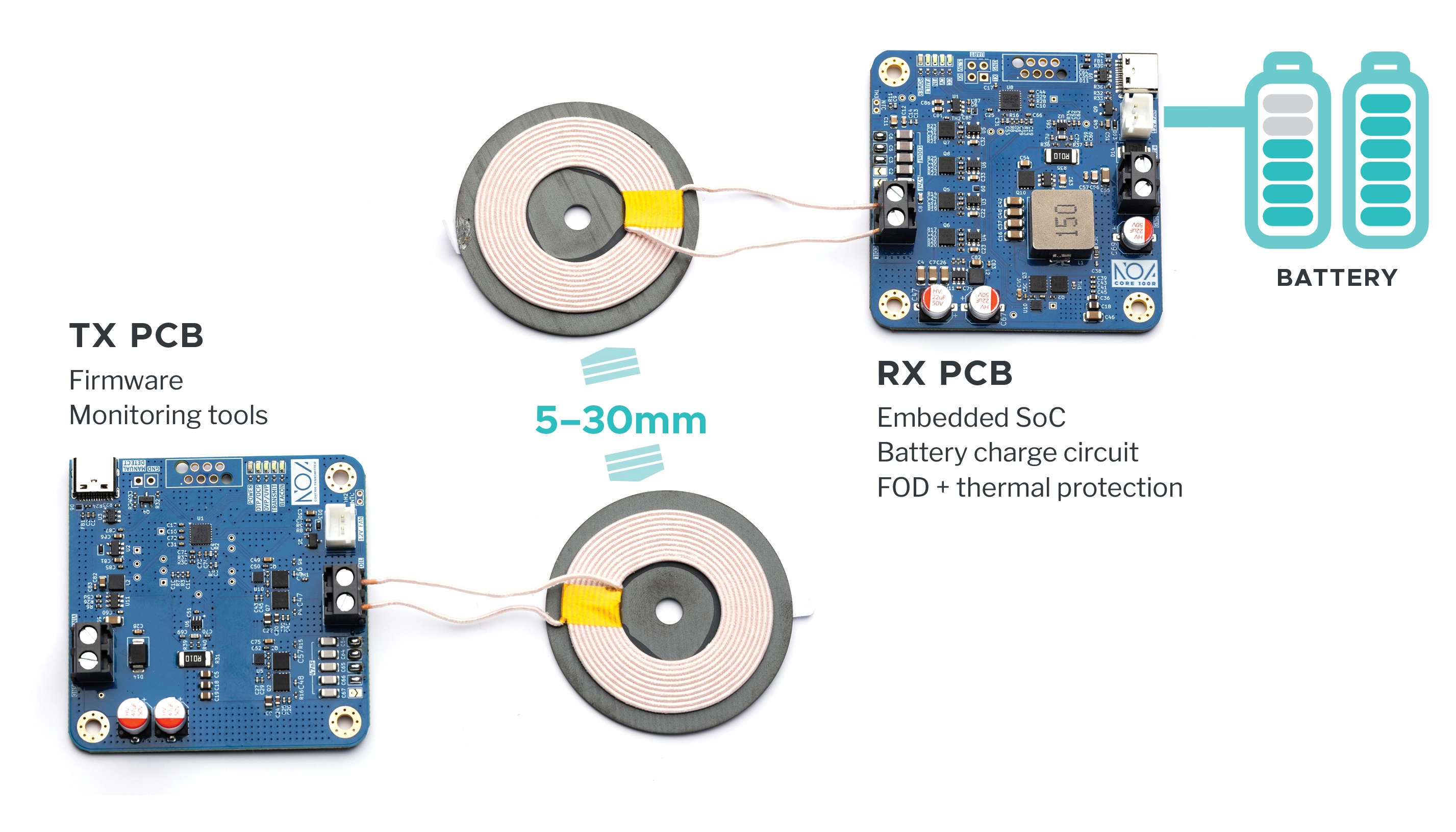
What we seed to engineering teams qualifying NOA on their own platform.
Matched 60 × 60 × 14 mm TX and RX boards — under 25 g each. Thin enough to integrate inside drone airframes, robot bellies, and wearables that competing wireless systems can't fit. Rated up to 100 W continuous.
Three coil pairs in the box — 35 mm, 50 mm and 75 mm. Match coil diameter to your platform's air gap, alignment tolerance and form factor without redesigning the electronics.
Plug USB-C into the module, open the configurator, tune voltage, current, duty cycle, frequency. Switch between battery-charge, constant-voltage and constant-current regulator modes from the browser.
For engineers who want raw rectified output to feed their own regulator, a single solder jumper drops NOA's onboard regulation out of the path.
Foreign-object detection (FOD), over-current protection (OCP) and over-voltage protection (OVP) cut power in under 2 ms. Standby draw stays below 0.5 W. No bolted-on safety MCU required.
OEMs that move past evaluation can customise both the hardware and the firmware. Design-in support is paired one-to-one with the integration team — not a downloadable SDK.
The Dev Kit is the lower bound of the platform. The architecture scales to 500 W on the same protections, the same configurator, the same workflow.
NOA offers pre-compliance support, EMI/EMC guidance, and detection and safety validation for customers. Full certifications relevant to your jurisdiction (CE, FCC, MIL-STD, etc.) are confirmed during integration and matched to the deployment context.
The Dev Kit is one node in a power family. Same protections, same configurator, same integration workflow at every scale. Above 500 W, NOA engages on a project / partnership basis — higher-power builds are scoped one-to-one with the integration team.
The lower bound of the platform — 1 W to 100 W on the same architecture every step up. Bench-tested, integrated and characterised by engineering teams qualifying NOA on their own platform.
Orderable today as a Dev Kit. Backwards-compatible with 100 W applications and forward-compatible with most industrial fleet hardware. Same architecture, broader power envelope.
The upper bound of the standard product family — heavy platforms, large robotics, marine ROVs, ground vehicles. Above this, NOA engages on a project / partnership basis to scope the build to the platform.
NOA is designed in Australia and engineered in Sydney, with operations across two spaces. The team works out of Cicada Innovations — Australia's deeptech incubator at Eveleigh, Sydney — alongside the country's largest deep-tech and hardware community, and from NOA's R&D and engineering facility in North Sydney where the day-to-day build happens. Manufacturing capability is being scaled under the current raise. The supply chain is Australian-sourced for critical components, by deliberate decision.
The capability is designed to fit AUKUS Pillar 2 sourcing requirements from day one — no retrofitted compliance documentation.
Three questions surface on almost every integration call. The short answers are below — the full engineering FAQ goes deeper.
Yes — for retrofits. If the chassis is locked and you're adding wireless to an existing platform, NOA can sit alongside pogo pins as a redundancy path. New designs typically drop the pins entirely once integration is proven. The extra grams, the extra BOM line, and the failure mode you've now built in stop being worth it.
Most wireless power vendors target either extreme power (EV-class kilowatts) or extreme distance (over-the-air). Both impose cost and integration burdens that don't suit autonomous robotics or drones. NOA is engineered for the platforms running the field. Tight spaces. Weight budgets that move grams. Mixed environments where one design ships into rain and one into dust. Cool-running architecture that gives integrators flexibility on cooling — fans, heat sinks, or vented enclosures, depending on the platform. Certification owned by your team.
Competing wireless solutions typically rely on fans or oversized heat sinks to manage thermal load. NOA's architecture runs at 28 °C under continuous operation, which gives platform integrators real choice on cooling — passive heat sinks, vented enclosures, or fans depending on the application and how tight the cavity is. Dev kits ship with bench fans so engineers can push to the upper edge of the spec safely; production cooling is a platform-design decision. The low thermal output matters for sensor-laden platforms, covert deployments, and any enclosure that has to stay sealed.